
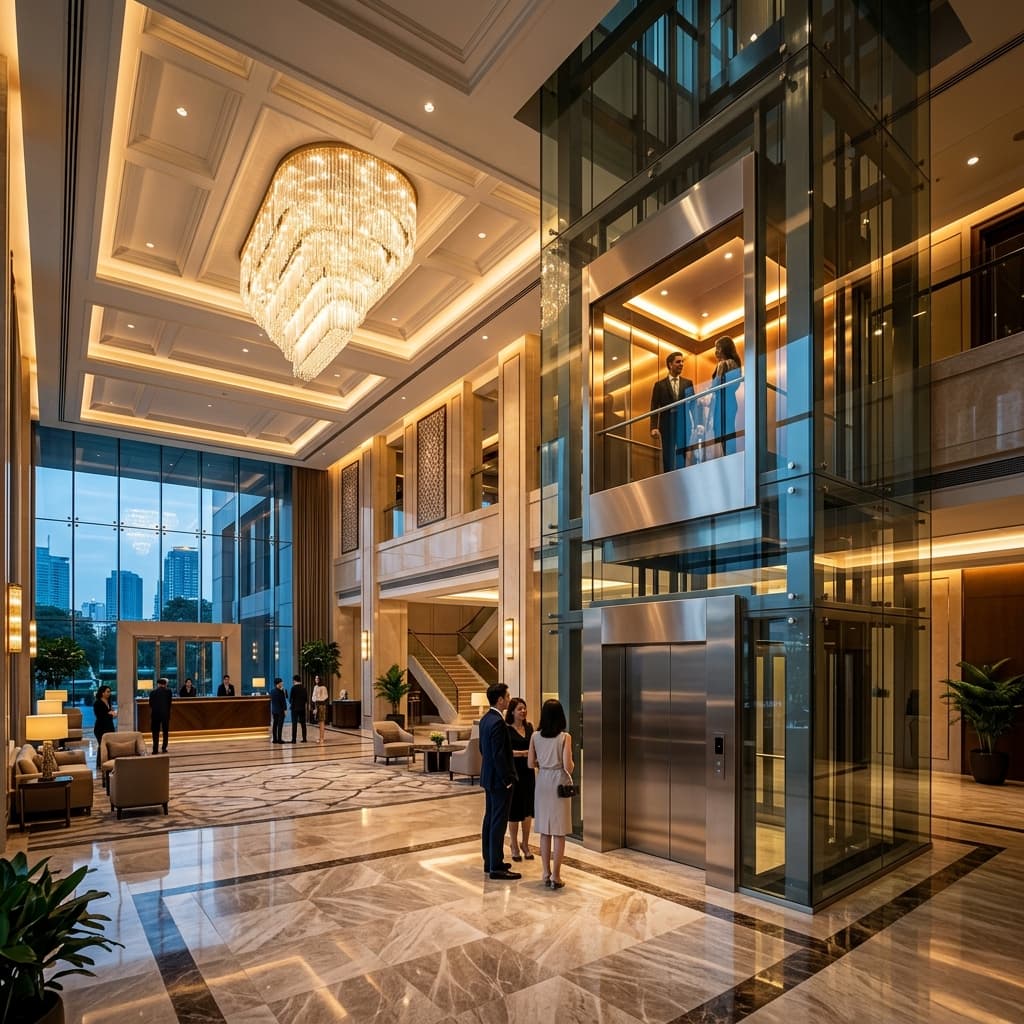
Introduction
An elevator is a long-term investment, and like any precision engineered system, its performance and lifespan depend entirely on the quality of maintenance it receives. With proper care, a quality elevator reliably serves a building for 20\u201325 years \u2014 sometimes longer. Neglect that same elevator, and you face breakdowns, safety hazards, and costly premature replacement within a decade.
This guide covers everything you need to know about elevator maintenance: daily and periodic checks, detailed subsystem care, how to evaluate AMC contracts, early warning signs of trouble, and when to repair versus replace. We also include specific recommendations for Chennai\u2019s coastal climate, where humidity, salt-laden air, and power fluctuations create unique maintenance challenges.
Routine Maintenance
Routine maintenance is the foundation of elevator reliability. It is divided into daily checks performed by building staff and periodic inspections carried out by qualified technicians.
Daily Checks (Building Staff)
- Verify the car levels correctly at each floor \u2014 mis-levelling indicates brake or encoder issues
- Listen for unusual noises during operation: grinding, squeaking, or thumping
- Confirm doors open and close fully without hesitation or reversal
- Check cabin lighting, ventilation fan, and emergency alarm function
- Ensure landing door interlock indicators show all doors securely closed
- Verify the emergency intercom or telephone reaches the designated responder
Weekly Checks (Trained Technician)
- Inspect governor tension and rope condition
- Clean door tracks and sensor lenses
- Check oil levels in hydraulic systems and gearboxes
- Verify emergency lowering device or ARD battery charge
- Test safety circuit operation by simulating a door interlock fault
Cleaning & Lubrication
Friction is the enemy of every moving part in an elevator. Proper cleaning and lubrication reduce wear, minimise power consumption, and prevent overheating.
Guide Rails
Guide rails guide the car and counterweight smoothly along the shaft. They must be kept clean and properly lubricated. Use a guide rail lubricator wick assembly that applies a thin, even film of oil as the car moves. In Chennai\u2019s humid climate, check lubricators monthly \u2014 high humidity can wash away oil films and promote rust formation on exposed rail surfaces.
Door Tracks & Hangers
Door systems accumulate dust, debris, and dried grease over time. Clean landing and car door tracks weekly using a non-conductive solvent. Lubricate hanger rollers and hinges with a lithium-based grease. Avoid over-lubrication \u2014 excess grease attracts dust and forms an abrasive paste.
Hoist Ropes & Sheaves
Inspect hoist ropes monthly for: broken strands, uniform tension across all ropes, reduction in diameter (measure with a rope gauge), and signs of corrosion. In coastal Chennai, stainless steel or galvanised ropes offer significantly longer life. Never apply lubricant directly to ropes \u2014 use a specified rope dressing sparingly, and only if the manufacturer recommends it.
Door System Maintenance
Door systems are the most frequently cycled components in any elevator and account for 60\u201370% of all service calls. Every landing door and car door opens and closes hundreds of times daily in a commercial building. This relentless use demands focused attention.
- Check door operator belt tension monthly \u2014 loose belts cause erratic movement and premature wear
- Clean and inspect door rollers for flat spots or sideplay
- Verify door interlock switches are correctly aligned and making positive contact
- Test re-opening sensors (infrared or safety edge) weekly \u2014 blocked sensors are a common failure
- Lubricate door hanger bearings, hinges, and latch mechanism every quarter
- Inspect door panels for distortion, loose screws, or damaged cladding
Electrical & Controller Systems
Modern elevators rely on microprocessor-based controllers and VVVF (Variable Voltage Variable Frequency) drives. These electronic systems are sophisticated but vulnerable to power quality issues and environmental factors \u2014 both significant concerns in Chennai.
VVVF Drives
VVVF drives control motor speed and torque electronically, delivering smooth acceleration and deceleration. They generate heat during operation and require adequate ventilation. In Chennai\u2019s warm climate, ensure the machine room or controller enclosure has active cooling when ambient temperatures exceed 40\u00b0C. Dust accumulation on drive heat sinks is a leading cause of drive failure \u2014 clean heat sinks and cooling fans every quarter.
Microprocessor Controllers
The controller is the brain of the elevator. It processes hall calls, car calls, position signals, and safety circuit status to dispatch the car efficiently. Periodic firmware updates from the OEM can improve performance and address known issues. In Chennai, consider installing a servo voltage stabiliser dedicated to the elevator controller and drive \u2014 voltage fluctuations common during summer months can corrupt controller memory or damage input/output modules.
Wiring & Connections
Loose connections, corroded terminals, and chafed insulation are common in older installations. Annually, a technician should open all junction boxes and control panels to verify terminal tightness and inspect for signs of overheating (discoloured insulation, burnt smell). Coastal buildings benefit from dielectric grease on all exposed electrical connections.
Motor & Drive System
The motor and drive assembly converts electrical energy into the mechanical force that moves the elevator. Whether you have a geared traction, gearless, or hydraulic system, the motor needs regular attention.
Brake Adjustment
The brake stops and holds the elevator at floor landings. Improper brake adjustment causes rough stops, rollback (creep), and accelerated lining wear. Brake linings should be inspected every quarter and replaced when thickness falls below the manufacturer\u2019s minimum. Air gap between brake shoes and drum should be checked and adjusted annually. In coastal Chennai, inspect brake contact surfaces for corrosion every 3 months.
Sheave & Rope Inspection
The drive sheave transmits motor torque to the hoist ropes. Inspect sheave grooves for wear pattern uniformity \u2014 uneven groove wear indicates rope tension imbalance. Check rope-to-groove fit: a rope should sit slightly above the groove bottom but not ride on the groove edges. Replace sheaves when groove depth exceeds the manufacturer\u2019s discard limit.
Hydraulic System
Hydraulic elevators use a pump driven motor to push oil into a cylinder, raising the car. They are common in low-rise buildings and warehouses across Tamil Nadu. Hydraulic systems require specific maintenance routines.
- Oil Levels: Check the oil reservoir monthly. Low oil levels cause rough operation, valve cavitation, and pump damage. Use only the oil grade specified by the manufacturer \u2014 typically ISO VG 32 or 46.
- Oil Leaks: Inspect the cylinder, pipe fittings, valve manifold, and pump seal for leaks. A small drip can become a major leak quickly. Hydraulic oil leaks also create slip hazards in the machine room.
- Oil Filtration: Change the oil return filter annually. Contaminated oil causes valve sticking, erratic movement, and accelerated pump wear. In Chennai\u2019s humid conditions, check for water contamination in the oil (milky appearance) every 6 months \u2014 condensation inside the tank is common.
- Pressure Settings: Verify system relief valve pressure settings annually. Incorrect pressure causes either weak performance or excessive stress on pipes and seals.
MRL Maintenance
Machine Room Less (MRL) elevators are increasingly popular in Chennai for both homes and commercial buildings. By eliminating the machine room, the machinery sits inside the shaft itself, which introduces specific maintenance considerations.
Belt Drives
Most modern MRL elevators use polyurethane-coated steel belt drives instead of traditional steel ropes. These belts offer excellent ride comfort and efficiency but require specialised inspection. Check belts monthly for: surface cracks, edge fraying, steel cord exposure, and tension uniformity. Belt replacement is typically needed every 5\u20138 years depending on duty cycle. In Chennai\u2019s heat, belts degrade faster \u2014 ensure the shaft has adequate ventilation to keep ambient temperature below 45\u00b0C.
Compact Components
MRL elevators pack the motor, brake, and controller into a compact frame mounted at the top of the shaft or between guide rails. This tight packaging means heat dissipation is critical. Verify that cooling fans on the drive and controller are operational at every service visit. Dust accumulation on compact MRL components is a common failure mode \u2014 compressed-air cleaning should be part of the quarterly service.
Shaft Environment
Since the machinery lives inside the shaft, the shaft must remain dry and clean. Check for water ingress, especially during the monsoon. In Chennai, shafts in coastal buildings should be treated with anti-corrosion coatings on all exposed metallic surfaces.
AMC Explained
An Annual Maintenance Contract (AMC) is your primary tool for ensuring consistent, professional elevator care. A well-structured AMC eliminates the need to find a technician each time something goes wrong and typically costs less than paying for individual breakdown call-outs.
What to Look For
- Visit Frequency: A good AMC specifies the number of preventive maintenance visits per year. Minimum 12 (monthly). For high-traffic or coastal buildings, 18\u201324 visits annually is advisable.
- Response Time: Look for a guaranteed response time for breakdowns \u2014 ideally within 4\u20138 hours for urban Chennai, 12\u201324 hours for suburban or Tier-2 cities.
- Spare Parts Coverage: Basic AMCs exclude spares; comprehensive AMCs include all routine replacement parts (rollers, belts, switches, seals). Understand exactly what is covered.
- Genuine vs. Compatible Parts: Insist on genuine OEM spares. Non-genuine parts may be cheaper but can compromise safety, ride quality, and warranty.
- Annual Inspection: The contract should include a comprehensive annual inspection with a written report covering all subsystems.
- Exclusions: Read the fine print. Common exclusions include: structural repairs, major rewiring, load testing, and modernisation work.
Signs of Problems
Early detection of developing issues saves money and prevents passenger entrapment. These are the warning signs that every building manager and homeowner in Chennai should recognise:
- Noise: Grinding from guide rail contact, squeaking from dry door rollers, thumping from worn sheave bearings
- Ride Quality: Jerky starts, rough acceleration, vibration during travel, or a bouncing sensation at stops
- Levelling: Car stops 10 mm or more above or below the landing \u2014 indicates encoder, brake, or controller issues
- Doors: Slow opening/closing, intermittent reversal, doors reopening for no reason
- Response: Calls being ignored, long wait times, car bypassing floors
- Electrical: Flickering cabin lights, unexpected alarms, intermittent intercom failure
- Fluids: Puddles of oil near the machine room or at the pit floor
- Smell: Burning odour from the machine room indicates motor overheating or electrical fault
Repair vs Replace Decision
Every elevator owner eventually faces the repair versus replacement question. Use this framework to evaluate your situation objectively.
- Lower upfront cost — typically ₹25,000–₹1,50,000 per repair vs ₹3.5L–₹25L for replacement
- Minimal downtime — most repairs completed within 1–3 days
- No structural modifications needed — existing shaft, rails, and pit remain unchanged
- Ideal for elevators under 15 years with available OEM spares
- Can be combined with targeted modernisation (e.g., new controller only)
- Cumulative repair costs may exceed replacement cost within 3–5 years
- Obsolete components become harder and costlier to source
- Older elevators lack modern safety features (ARD, two-way communication, COP buttons)
- Energy efficiency remains poor — older motors and drives consume 30–50% more power
- May not comply with updated IS 14665 or Tamil Nadu Lift Act amendments
Decision Matrix
Consider replacement when: repair costs exceed 40% of replacement value, the elevator is 20+ years old, critical spare parts are discontinued, or the elevator fails a statutory safety inspection. Choose repair when: the issue is isolated, the elevator is under 15 years old, OEM spares are available, and repair costs are under 25% of replacement value.
Maintenance Schedule
Follow this structured schedule to ensure no aspect of your elevator\u2019s health is overlooked. The frequencies listed are minimum recommendations \u2014 increase intervals for high-traffic or coastal installations.
Monthly
- Clean and lubricate guide rails and door tracks
- Inspect brake function and measure air gap
- Test emergency alarm, intercom, and battery backup
- Verify door sensor operation and interlock alignment
- Check hoist rope tension and visible condition
- Inspect hydraulic oil level and pump operation
- Clean controller and drive cooling fans and heat sinks
- Record trip counts and fault logs from controller
Quarterly
- Full door system inspection (rollers, hangers, hinges, belts)
- Motor bearing inspection and re-greasing (if applicable)
- Check all electrical connections for tightness and corrosion
- Verify VVVF drive parameters and fault history
- Inspect governor and overspeed switch mechanism
- Lubricate landing door latches, hinges, and interlocks
- Clean pit (remove debris, check for water ingress)
Annually
- Complete statutory inspection per Tamil Nadu Lift Act
- Sheave groove wear measurement and rope diameter check
- Brake lining thickness measurement and replacement if needed
- Hydraulic oil filtration or replacement and filter change
- Load test at 125% of rated capacity
- Emergency rescue drill with building staff
- Controller firmware update (if available from OEM)
- Comprehensive written report with condition assessment
Every 5 Years
- Rope replacement (steel ropes) or belt replacement (MRL)
- Guide rail re-alignment check
- Hydraulic cylinder inspection (non-destructive testing)
- Complete control panel overhaul or replacement
- Machine room and shaft structural inspection
- Door operator replacement (high-cycle installations)
Cost Factors
Elevator maintenance costs vary significantly based on these key factors. Understanding them helps you budget accurately and evaluate AMC proposals.
- Elevator Type: Hydraulic elevators have higher maintenance costs due to oil, filters, seals, and pump wear. MRL elevators have moderate costs. Gearless traction elevators have the lowest routine maintenance cost but higher component replacement costs.
- Usage / Traffic: A home elevator used 20 times daily costs less to maintain than a commercial elevator cycled 200+ times daily. High-traffic installations need more frequent visits and faster component replacement.
- Age: Older elevators require more frequent repairs and may need custom-fabricated parts if OEM spares are discontinued. Budget 20\u201330% higher maintenance costs for elevators over 15 years.
- Location: Chennai coastal buildings face 10\u201315% higher service costs due to corrosion-related wear, more frequent lubrication needs, and specialised stainless steel or galvanised replacement parts.
- Spare Parts Quality: Genuine OEM parts cost more but last longer and maintain safety certification. Non-genuine parts can be 30\u201350% cheaper but may fail sooner and void warranty.
- Response Time Guarantee: AMC contracts with 4-hour response times cost more than those with 24-hour responses. For buildings with elderly residents or hospitals, priority response is worth the premium.
Elevator Maintenance FAQ
Common questions about elevator servicing, AMC contracts, and Chennai-specific care answered by our Service Department.
Service Department
After-Sales Service
Our service team manages AMC contracts for 300+ elevators across Chennai, Coimbatore, and Salem. They specialize in preventive maintenance, breakdown response, and modernization projects.
Continue Reading
How to Choose an Elevator
A comprehensive step-by-step guide covering elevator types, capacity, speed, safety, budget, and installation planning.
Elevator Safety Checklist
Essential safety checks for every elevator owner. Covers daily inspections, emergency systems, compliance, and maintenance.
Elevator Buying Guide for Chennai
Chennai-specific elevator buying advice covering local regulations, climate considerations, builder tips, and installation process.
Ensure Your Elevator\u2019s Longevity
Our service team manages 300+ AMC contracts across Chennai, Coimbatore, and Salem. Get a custom maintenance plan for your elevator.