
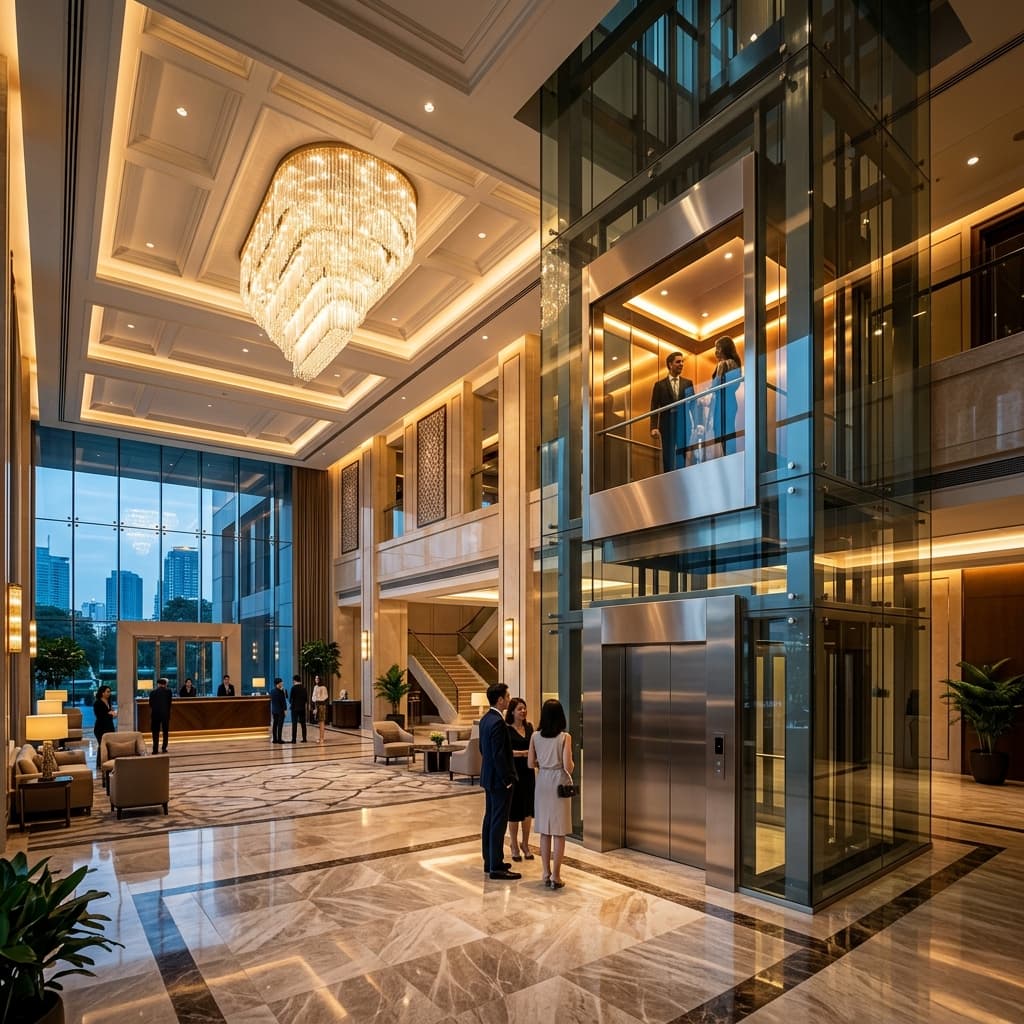
The Tamil Nadu Lifts, Escalators and Moving Walks Act is the primary legislation governing elevator safety across the state. Every building exceeding ground-plus-one-floor height must comply — residential apartments, commercial complexes, hospitals, hotels, and industrial facilities. Compliance requires CMDA or local municipal approval before installation, licensed contractors for installation, annual inspection by certified inspectors, and yearly license renewal. Non-compliance attracts penalties up to ₹25,000 and potential shutdown orders. This guide covers everything you need to know to stay compliant.
Introduction to Tamil Nadu Lift Rules
Tamil Nadu has one of the most comprehensive regulatory frameworks for elevators in India. The Tamil Nadu Lifts, Escalators and Moving Walks Act (hereafter referred to as the Tamil Nadu Lift Act) governs all aspects of lift installation, operation, maintenance, and safety across the state. This legislation, enforced through local municipal corporations, the Chennai Metropolitan Development Authority (CMDA), and the Tamil Nadu Electrical Inspectorate, ensures that every lift operating in the state meets stringent safety and technical standards.
Understanding these rules is not optional — it is a legal obligation for building owners, developers, apartment associations, and facility managers. Failure to comply can result in significant penalties, legal action, and most critically, safety hazards that endanger lives.
Applicable Laws and Regulations
Compliance in Tamil Nadu is governed by a multi-layered regulatory framework. Understanding the hierarchy and interaction between these laws is critical for building owners and compliance professionals.
Tamil Nadu Lifts, Escalators and Moving Walks Act
The principal state legislation that mandates licensing, inspection, and safety standards for all lifts, escalators, and moving walks operating in Tamil Nadu. It empowers local authorities to enforce compliance, conduct inspections, and levy penalties for violations.
IS 14665 (Bureau of Indian Standards)
The Indian Standard for electric traction lifts — covering design, construction, installation, operation, testing, and maintenance. IS 14665 is the technical backbone of lift safety in India and is referenced extensively in the Tamil Nadu Lift Act. All lifts installed in Tamil Nadu must conform to IS 14665 requirements for load capacity, speed, braking systems, door interlocks, emergency communication, and firefighting lifts.
Competent Person
As defined under the Tamil Nadu Lift Act, a Competent Person is an individual certified by the state government to inspect, test, and certify lifts for compliance. Competent Persons must hold recognized engineering qualifications, have minimum experience requirements, and be registered with the Tamil Nadu Electrical Inspectorate.
Lift Inspector
A government-appointed official responsible for verifying that lifts meet all regulatory requirements before licensing. The Lift Inspector reviews installation reports, conducts on-site inspections, and issues compliance certificates. In Chennai, Lift Inspectors operate under the CMDA framework.
Beyond the state act and IS standards, the following regulations also apply:
- CMDA Building Regulations: The Chennai Metropolitan Development Authority mandates that all buildings above 15 meters in height must have lift provisions. CMDA also approves lift drawings and conducts final inspections before issuing occupancy certificates.
- Local Municipal Corporation Bye-laws: Each municipal corporation in Tamil Nadu — Chennai, Coimbatore, Madurai, Tiruchirappalli, Salem, Tirunelveli, among others — has specific bye-laws governing lift installation approvals, license fees, and inspection schedules.
- Tamil Nadu Fire and Rescue Services: Buildings with lifts must comply with fire safety norms including firefighter lifts, smoke detection in lift lobbies, and emergency power backup for lifts during fire incidents.
- Electricity Rules: Lift electrical installations must conform to the Tamil Nadu Electricity Board (TNEB) regulations and the Indian Electricity Rules for safety, earthing, and power supply requirements.
Who Must Comply With Tamil Nadu Lift Rules?
The Tamil Nadu Lift Act applies to a broad spectrum of buildings and premises. Understanding whether your property falls under the act is the first step toward compliance.
All buildings with a height of ground floor plus one floor (G+1) or more that have a lift installed must comply. This includes:
- Residential apartment complexes and multi-dwelling units
- Commercial office buildings and business parks
- Shopping malls and retail complexes
- Hospitals, nursing homes, and healthcare facilities
- Hotels, resorts, and hospitality establishments
- Industrial facilities and factories with passenger or goods lifts
- Government and public sector buildings
- Educational institutions with multi-storey buildings
- Mixed-use developments combining residential and commercial spaces
Residential Buildings and Apartment Complexes
Residential compliance under the Tamil Nadu Lift Rules carries unique considerations. Unlike commercial buildings where a dedicated facility management team handles compliance, residential apartments often rely on owners associations or managing committees — which may lack technical expertise in elevator regulations.
Key residential compliance requirements include:
- License Responsibility: The apartment owners association or managing committee is legally responsible for obtaining and renewing the lift license annually.
- AMC Mandate: All residential lifts must have a valid Annual Maintenance Contract with a licensed elevator service provider. The AMC certificate is a mandatory document for license renewal.
- Visitor Safety: Residential lifts are used by residents, guests, domestic staff, and service personnel. The owners association must ensure that safety notices, load capacity placards, and emergency contact information are prominently displayed inside the lift cabin.
- Emergency Preparedness: Residential buildings must have emergency protocols for lift entrapment, including 24/7 emergency contact numbers and periodic entrapment drills.
Commercial Buildings and Business Complexes
Commercial buildings face stricter compliance requirements due to higher traffic volumes, diverse user profiles, and the critical nature of lift uptime for business operations. Office buildings, retail complexes, and co-working spaces in Chennai and across Tamil Nadu must maintain rigorous compliance standards.
Specific compliance considerations for commercial buildings include:
- Higher Inspection Frequency: While annual inspection is the minimum, commercial buildings with high traffic — especially shopping malls and IT parks — benefit from bi-annual or quarterly inspections to identify wear and tear before it becomes a safety issue.
- Firefighter Lifts: Commercial buildings above 15 meters must install a dedicated firefighter lift as per Tamil Nadu Fire and Rescue Services norms and NBC 2016 requirements.
- Emergency Power: Lifts in commercial buildings must have automatic transfer to emergency power during grid failure, with sufficient backup to complete at least one full cycle.
- Traffic Management: Multi-lift installations must have group control systems that optimize traffic flow while maintaining independent safety systems for each lift.
Hospitals, Hotels, and Specialized Facilities
Hospitals and hotels operate under heightened compliance requirements because their lifts serve vulnerable populations and must function reliably under all conditions. The Tamil Nadu Lift Rules include specific provisions for these facility types.
Hospital lifts (bed lifts) must comply with additional requirements under IS 14665 for stretcher and bed dimensions, smooth acceleration and deceleration profiles, backup power with extended duration, and infection control considerations for cabin surfaces. Hospitals must also have entrapment rescue protocols coordinated with their medical emergency response teams.
Hotel lifts must meet accessibility requirements for guests with disabilities, including braille controls, audio announcements, and sufficient cabin dimensions for wheelchair maneuverability. Hotels in Chennai and other Tamil Nadu cities must also ensure that lifts comply with tourism department star-rating requirements.
Safety Requirements Under Tamil Nadu Lift Rules
The Tamil Nadu Lift Rules mandate comprehensive safety requirements that every lift installation must meet. These requirements are designed to protect passengers, maintenance personnel, and building occupants.
Essential safety features required for all lifts:
- Door Interlocks: Mechanical and electrical interlocks that prevent the lift from moving unless all doors are closed and locked. Conforms to IS 14665 Section 7 requirements.
- Overspeed Governor: A mechanical device that activates the safety gear if the lift exceeds its rated speed by 15%. Must be tested and certified annually.
- Safety Gear: Mechanical braking system that physically grips the guide rails in the event of free fall or overspeed. Must be capable of stopping and holding the fully loaded car.
- Emergency Communication: Two-way communication system (intercom or telephone) inside the cabin that connects to a 24/7 manned response center. Must be battery-backed.
- Emergency Lighting: Auto-activating lighting inside the cabin that provides at least one hour of illumination during power failure.
- Fire Recall Operation: Automatic return of the lift to the designated landing floor upon fire alarm activation, after which doors open and the lift is taken out of service.
- Load Weighing Device: A sensor that prevents the lift from moving if the cabin load exceeds the rated capacity. Must provide visual and audible overload indication.
- Terminal Limit Switches: Redundant switches at both ends of the hoistway that stop the lift if it overruns the normal travel limits.
Installation Standards and Approval Process
Installing a new lift in Tamil Nadu requires approval at multiple stages. Attempting to bypass any step can result in the lift being ordered out of service and the owner facing penalties.
Step 1 — Drawing Approval: Before any installation work begins, detailed lift drawings must be submitted to CMDA (for Chennai) or the relevant local municipal authority. Drawings must include shaft dimensions, machine room layout, guide rail specifications, door openings, pit depth, overhead clearance, and structural loading calculations. These drawings must be sealed by a licensed structural engineer.
Step 2 — Contractor Licensing: Only licensed elevator contractors registered with the Tamil Nadu Electrical Inspectorate may install lifts. Using an unlicensed contractor invalidates the installation approval and exposes the owner to penalties.
Step 3 — Installation: Installation must strictly follow approved drawings and IS 14665 standards. Any deviation from approved drawings requires re-submission and re-approval.
Step 4 — Inspection: Upon completion, a Competent Person or Lift Inspector conducts a comprehensive inspection including load testing, safety gear testing, and full functional verification.
Step 5 — License Issuance: After successful inspection, the local authority issues the operating license. The license must be displayed inside the lift cabin and renewed annually.
Inspection Requirements and Compliance Checks
Regular inspection is the cornerstone of lift safety under Tamil Nadu regulations. The law mandates annual inspection by a certified Competent Person, but the inspection regime involves multiple layers.
Annual Statutory Inspection: Every lift in Tamil Nadu must undergo a comprehensive annual inspection by a Competent Person registered with the Tamil Nadu Electrical Inspectorate. The inspection covers:
- Full load test at rated capacity with overload trip verification
- Safety gear test — car overspeed and governor activation
- Door interlock and door closing force measurement
- Brake system inspection and stopping distance measurement
- Guide rail alignment and wear measurement
- Wire rope condition, lubrication, and tension measurement
- Electrical insulation resistance and earthing continuity
- Emergency communication system functional test
- Emergency lighting and fire recall operation test
- Landing zone accuracy and re-leveling function
Inspection Report Requirements: The Competent Person must prepare a detailed inspection report in the format prescribed by the Tamil Nadu Electrical Inspectorate. The report includes findings, measurements, test results, and a clear PASS/FAIL determination. If the lift fails inspection, a rectification notice is issued with specific non-compliances that must be addressed before re-inspection.
Owner Responsibilities Under Tamil Nadu Lift Rules
The Tamil Nadu Lift Act places primary compliance responsibility on the building owner. This cannot be delegated to a contractor, service provider, or facility manager — though you may engage professionals to assist, the legal liability remains with the owner.
- Obtain CMDA or local authority approval before any new lift installation
- Ensure installation is carried out by a licensed elevator contractor registered with Tamil Nadu Electrical Inspectorate
- Register the lift with the local municipal corporation within 30 days of installation
- Sign an Annual Maintenance Contract (AMC) with a licensed elevator service provider
- Display the current lift operating license prominently inside the cabin
- Schedule annual statutory inspection by a Competent Person before license expiry
- Submit the inspection report and AMC certificate for license renewal at least 30 days before expiry
- Maintain a compliance file with all inspection reports, AMC records, and correspondence with authorities
- Post safety notices including load capacity, emergency contacts, and usage instructions inside the cabin
- Ensure 24/7 emergency call-out service is available through the AMC provider
- Implement a monthly self-inspection program using a standardized checklist
- Keep emergency rescue equipment (key, tools) accessible and train security personnel in basic rescue procedures
- Upgrade older lifts to meet current IS 14665 standards within the transitional period
- Maintain lift operation logs documenting all faults, repairs, and maintenance activities
Penalties for Non-Compliance
The Tamil Nadu Lift Act prescribes specific penalties for non-compliance. These penalties have been strengthened in recent amendments to deter violations and improve safety outcomes across the state.
- Operating Without a License: Fine up to ₹25,000 for the first offense. Repeat violations attract higher penalties and potential prosecution under the Tamil Nadu Lift Act. The local authority may also seal the lift and disconnect power supply.
- expired License: Late renewal attracts a penalty fee in addition to the standard renewal charges. Continued operation after expiry without renewal is treated as operating without a license.
- Non-Compliant Installation: Installing a lift without approved drawings or using an unlicensed contractor can result in fines, removal orders, and denial of occupancy certificate by CMDA.
- Safety Violations: If an inspection reveals critical safety violations, the lift is immediately taken out of service. Re-inspection fees apply, and the owner must bear the cost of rectification before the lift can resume operation.
- Accidents Due to Negligence: In case of a lift accident caused by owner negligence — such as failed maintenance or ignored safety warnings — the owner may face criminal liability in addition to civil penalties under the Tamil Nadu Lift Act.
Common Compliance Violations and How to Avoid Them
Based on our experience working with property owners across Tamil Nadu, these are the most frequent compliance violations we encounter:
- Ignoring License Renewal Dates: The most common violation. Building owners often forget to renew annually. Solution: Set calendar reminders 60 days before expiry and start the renewal process early.
- Missing AMC Coverage: Operating without a valid AMC or allowing the AMC to lapse between service providers. Solution: Ensure continuous AMC coverage through back-to-back contracts.
- Using Non-Certified Service Providers: Hiring unlicensed technicians for repairs or maintenance. Solution: Verify that your service provider is registered with the Tamil Nadu Electrical Inspectorate.
- Expired or Missing License Display: Failing to display the current year's license inside the cabin. Solution: Display the license in a weather-protected frame immediately after receipt.
- Non-Functional Emergency Communication: Emergency intercom or phone not working or not connected to a manned response center. Solution: Test emergency communication weekly.
- Overloaded Operation: Allowing lift operation beyond rated capacity. Solution: Install load weighing devices and enforce capacity limits through building management.
Important Documents for Compliance
Maintaining proper documentation is essential for demonstrating compliance with the Tamil Nadu Lift Rules. The following documents must be kept on file and produced upon request by inspecting authorities:
- Current Lift Operating License: The valid license issued by the local authority. Must be displayed inside the cabin.
- Approved Lift Drawings: CMDA or local authority approved drawings with stamps and approval letters.
- Installation Certificate: Certificate from the installing contractor confirming IS 14665 compliance and workmanship standards.
- AMC Contract: Current Annual Maintenance Contract with a licensed elevator service provider, including scope of service and response time commitments.
- Annual Inspection Report: Most recent inspection report from a Competent Person, including load test results and safety gear test certificates.
- Maintenance Logs: Records of all maintenance visits, repairs, and parts replacements throughout the year.
- Certificate of Conformity: Manufacturer's certificate confirming the lift model meets all applicable IS standards.
- Emergency Response Plan: Documented procedures for lift entrapment rescue, including 24/7 contact numbers and rescue equipment locations.
- Building Approval: CMDA building plan approval showing lift provisions and shaft dimensions approved during construction.
Frequently Asked Questions
Frequently Asked Questions
Asco Compliance Team
Regulatory Affairs Division
Our compliance team specializes in elevator regulations, approvals, and licensing across Tamil Nadu. With years of experience navigating CMDA, local municipal, and Tamil Nadu government processes, they ensure every Asco installation meets all legal requirements.
Continue Reading
Lift Approval Process in Chennai
Step-by-step guide to getting elevator approval in Chennai. From drawing submission to final inspection and certification.
Lift License Application Guide
Complete guide to applying for an elevator license in Tamil Nadu. Documents, fees, inspection process, and renewal information.
Annual Lift Renewal Guide
Everything about annual elevator renewal in Tamil Nadu — inspection, fees, documents, late penalties, and expert tips.
Need Compliance Assistance?
Our compliance team can guide you through the entire approval, licensing, and renewal process. Get expert support for your elevator compliance requirements in Tamil Nadu.
Expert guides for choosing the right elevator
Side-by-side comparison of all elevator types
Explore Asco's complete elevator range
Service coverage across Tamil Nadu
Get a free project quotation
Speak with our compliance team